
Waxhaw Directory Routes at a Glance
Waxhaw people directories do not form one master list. Each official directory records a specific relationship: service to the Town, work within a school system, ownership of a parcel, appearance in a recorded transfer, or a role in a registered business. Historical directories add an earlier time layer. The best starting point is the list whose reason for naming a person matches the question being asked.
| Directory source | People represented | Record keeper | How to browse |
|---|---|---|---|
| Waxhaw staff roster | Town staff and officials | Town of Waxhaw | Free online browse |
| UCPS staff directory | School system personnel | Union County Public Schools | Free online directory |
| Property roll and UC Atlas | Current parcel owners | Union County Tax Administration and GIS | Free owner, address, parcel, or map search |
| Register name index | Grantors, grantees, assumed names, and notaries | Union County Register of Deeds | Online index plus office holdings |
| State license and entity lookups | Credential holders and business agents | North Carolina boards and Secretary of State | Free official searches |
| Monroe city directories | Named residents, spouses, and businesses | DigitalNC | Seven intermittent digitized volumes |
Start with the Town roster for an official contact and UCPS for a school contact. Use the county property directories when a name or address is tied to land. A business name belongs in state entity records, while an older household may appear only in a Monroe volume, newspaper, tax list, or archive series. Waxhaw’s small-town setting makes countywide and Monroe-titled sources especially important.
Note: A directory entry proves the listed role at a point in time, not a person’s present home or current status.
Inside Waxhaw’s Staff Directory
The official Waxhaw staff directory held 95 entries over four pages when inspected. It is a paginated roster, not a resident directory. Its rows cover the Town Clerk, permitting staff, the cemetery manager, department heads, commissioners, and police personnel. First, Prev, numbered pages, Next, and Last controls move through batches of entries.
A typical Waxhaw directory entry contains:
- a linked employee name;
- the person’s title;
- one or more Town departments;
- a work phone, sometimes with an extension; and
- an Email link and possible detail view.
The directory omits home addresses and private phone numbers. If a name is missing, use the department’s main line or contact the Town Clerk, Barbara Bruce, at 704-843-2195 ext. 238. CivicWeb can also show named staff report authors, appointed board members, attendance, and votes. Those meeting records supplement the current staff list without turning it into a general population index.
Waxhaw School Directory Paths
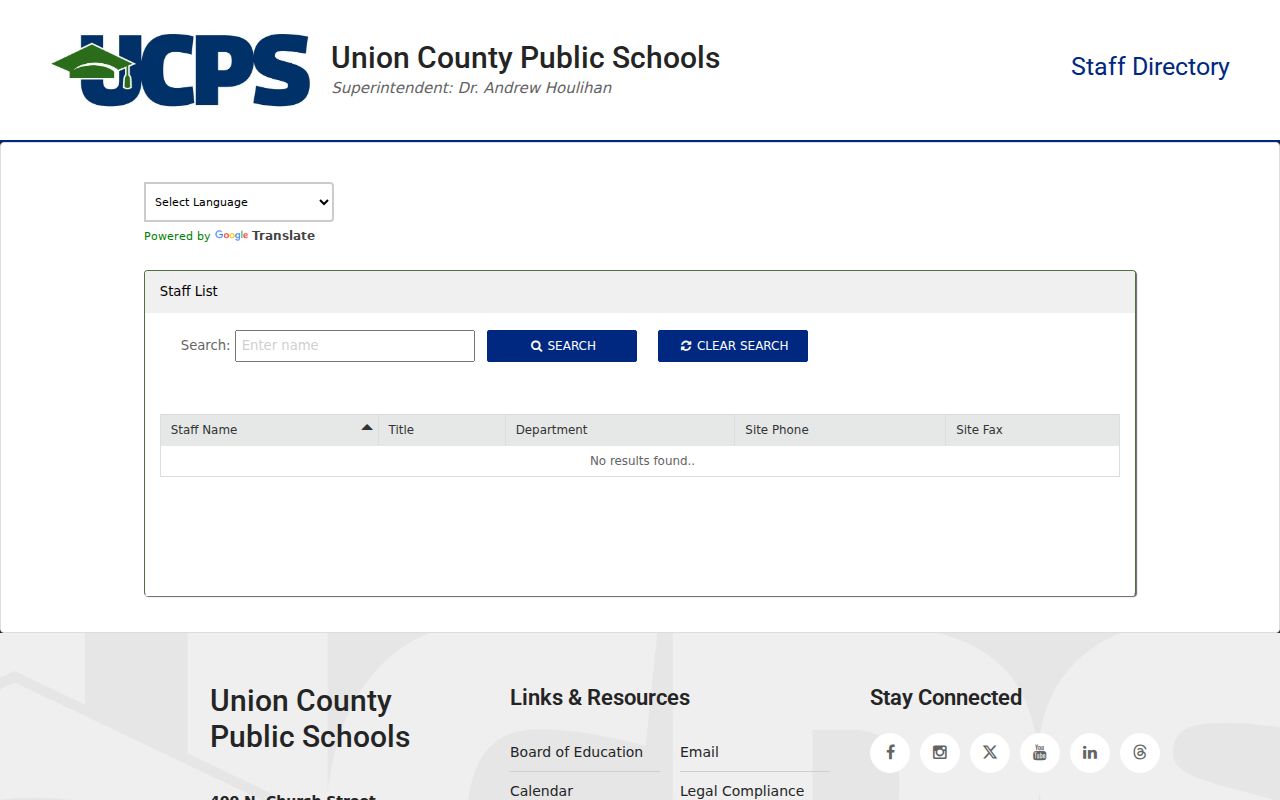
The UCPS Staff Directory is the main education roster for Waxhaw-area schools. Its result columns are Staff Name, Title, Department, Site Phone, and Site Fax. The separate UCPS school directory lists each school’s name or type, main phone, street address, and site link. Together, the two directories distinguish a person from the campus where that person serves.
The UCPS search screen shows how the school directory presents personnel entries.
Waxhaw-address campuses in the research include Cuthbertson High and Middle, Marvin Ridge High and Middle, New Town Elementary, Rea View Elementary, South Providence, and Waxhaw Elementary. A postal address does not settle a school boundary or Town limit, so treat the campus label as a contact fact, not proof of municipal geography.
Note: Exact digitized yearbook coverage for Waxhaw-area schools was not confirmed; ask UCPS, the library, or the archives by school and year.
Nearby Education Directory Filters
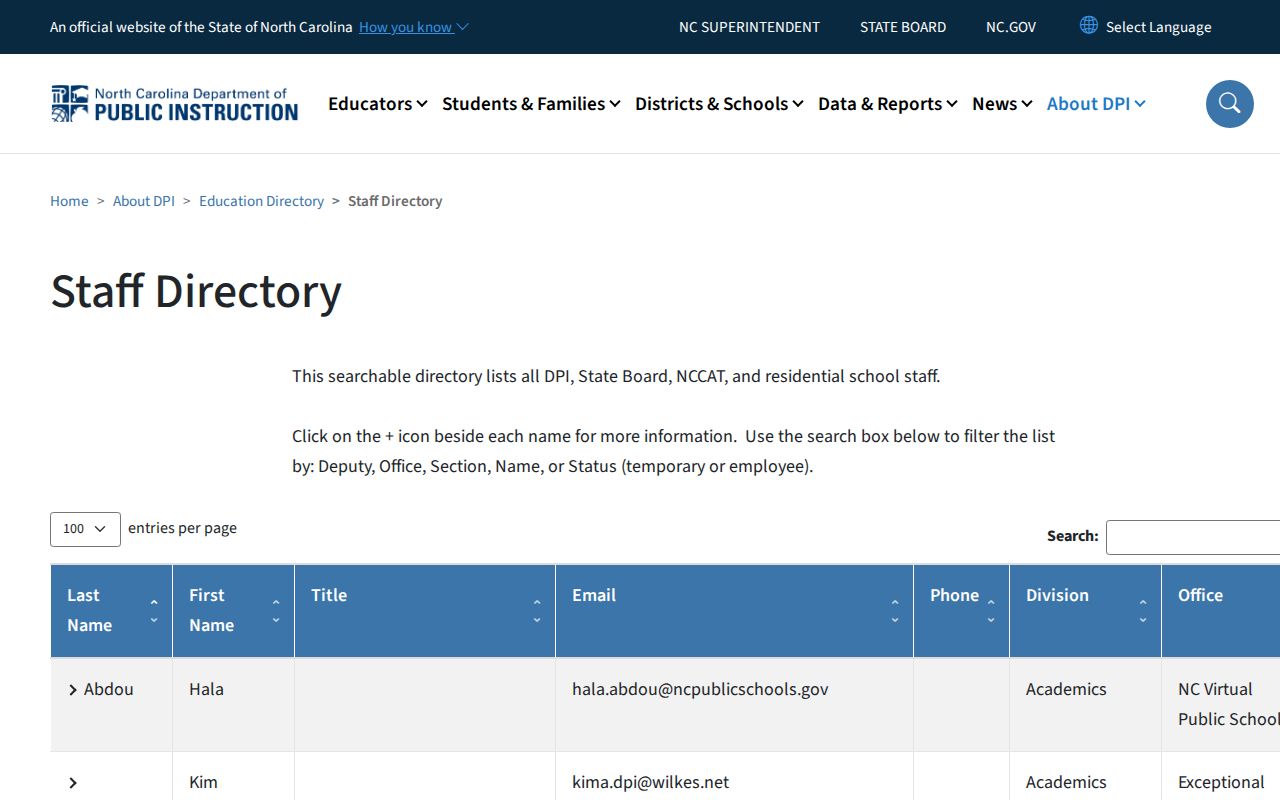
State and nearby university directories can resolve a role when the local school roster is too narrow. The NC DPI staff directory covers Department of Public Instruction, State Board, and residential education personnel. Wingate University’s public directory was broader at inspection, with 857 entries shown 30 per page across 29 pages. Because Wingate also lists Hendersonville personnel, its Location filter is essential.
The Wingate directory exposes a useful, documented field set:
| Search field | Control | Required | Use |
|---|---|---|---|
| Keyword | Text | No | Search a role or term |
| First Name | Text | No | Narrow a known person |
| Last Name | Text | No | Primary surname search |
| Location | Filter | No | Separate campus results |
| Department | Filter | No | Limit by unit |
The state education roster offers a second official directory surface.
Use these rosters for official contact and role checks. They are not alumni lists. No official public neighborhood, congregation, alumni, or civic-club resident roster was found, and many such lists remain private by design.
Waxhaw Owner and Deed Directories
Public record sets can act like people directories when a person has a documented role. The Union County Property Portal accepts owner name, property address, or parcel ID. Its parcel card can show owner names, mailing and situs addresses, legal or subdivision description, acreage, values, sales, and book/page references. A mailing address is where the tax bill goes, so it does not by itself show who lives on the parcel.
The Register of Deeds index is different. Its land-records instructions explain the name-based system, which organizes grantors and grantees along with other recorded roles. The simplified lookup covers online deeds from 1973 and maps from 1842; earlier deeds and mortgage material require the Register’s Monroe office. Book and page can bridge a parcel card to the recorded instrument. The county's GIS documentation explains UC Atlas updates and limits. The broader access-law and copy process belongs with Waxhaw public records access.
- Situs address
- The physical location of a parcel.
- Mailing address
- The destination for the owner’s tax bill.
- Grantor and grantee
- The parties transferring and receiving an interest in a recorded document.
- Reverse directory
- A list used to move from an address to a named occupant.
Waxhaw Business and License Directories
The North Carolina Business Registration Search is the official entity directory. Search by entity name or other available mode, then inspect legal name, SOS ID, entity type, status, formation date, registered agent and office, principal office, and filing history or officers where filed. Search spelling variants and dissolved names. A registered agent accepts legal process and is not necessarily the beneficial owner.
Professional boards maintain narrower directories. The State Bar, Medical Board, Board of Nursing, Real Estate Commission, General Contractors Board, and cosmetology board commonly accept a name or license number. Results may show credential type, status, public contact location, and discipline where authorized. Assumed names recorded in Union County and Waxhaw permit files add local roles such as applicant, owner, business, or contractor.
These directories document a role on a date. The Chamber member directory is different again: it lists participating businesses and representatives that choose publication, not every business or Waxhaw resident.
NC Cash as a Name Directory
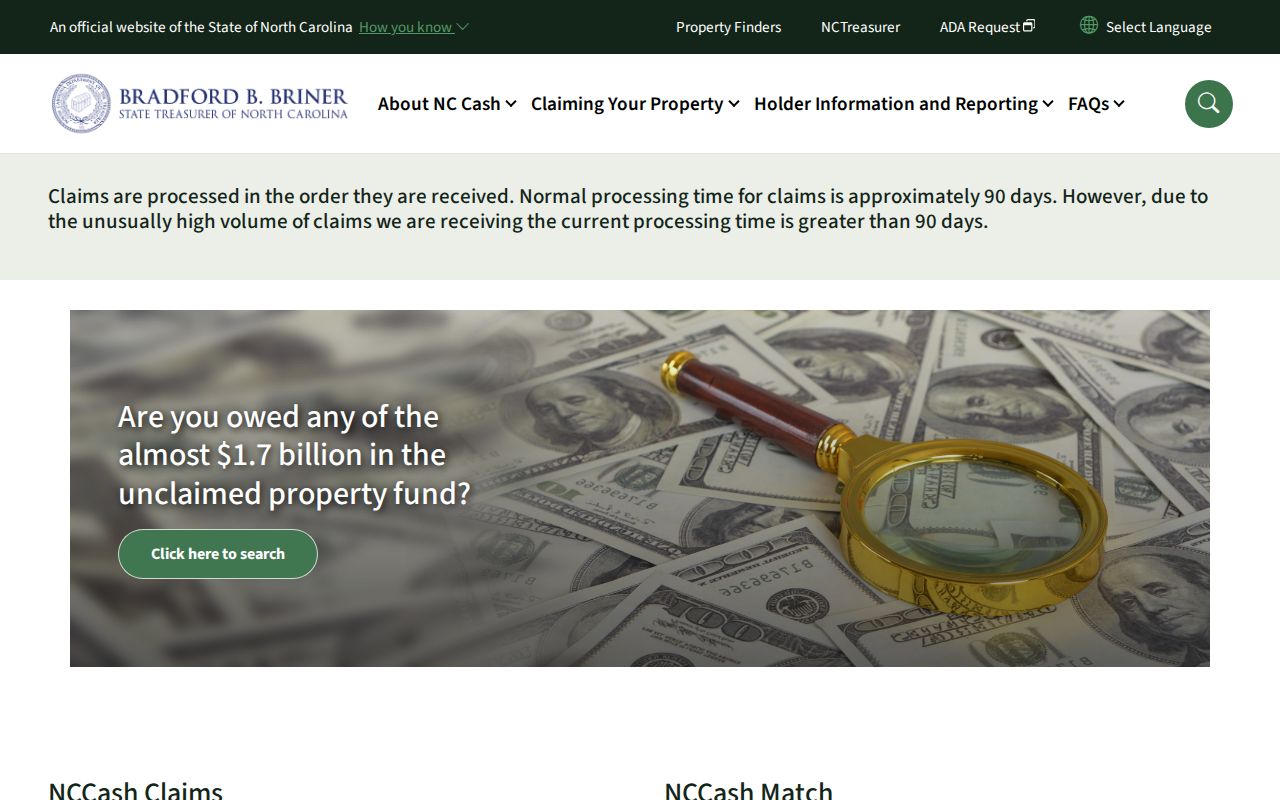
NC Cash, operated by the North Carolina Department of State Treasurer, is a focused name directory for unclaimed property. Its search accepts owner, co-owner, and location details. A possible match can support a family or estate trail, but it does not prove present residence or ownership of land. Claims begin through the official system rather than an upfront-fee solicitation.
The official NC Cash screen shows the public starting point for this special directory.
Use a middle initial, co-owner, or prior locality to sort common names. Then compare any promising result with an obituary, estate file, deed, or historical directory before deciding that two records concern the same person.
Note: An unclaimed-property match is a lead for lawful personal research, not proof that the named person still lives near Waxhaw.
Historical Waxhaw Directory Years
Waxhaw lacks a confirmed continuous city-directory run. The exact physical city, phone, and reverse-directory shelf years at the Dickerson Genealogy and Local History Room were not published online. The confirmed digital set is a group of Monroe directories at DigitalNC. Nearby residents may appear as “r Waxhaw, N.C.” with a name, spouse or widow notation, occupation or business, and residence.
| Confirmed volume | Publisher detail | Coverage note |
|---|---|---|
| 1922–23 | Commercial Service Company | Monroe title with possible Waxhaw-area entries |
| 1942–43 | Later series | Intermittent, not a continuous run |
| 1951–52 | Southern Directory Company era | Search surname and rural-route forms |
| 1955–56 | Southern Directory Company era | Check spouse and occupation fields |
| 1958–59 | Southern Directory Company era | Compare with newspapers and deeds |
| 1960–61 | Southern Directory Company era | Old route numbers may not match today |
| 1962–63 | Southern Directory Company era | Latest confirmed digital volume in research |
The seven volumes are separate DigitalNC records, not verified Dickerson Room holdings. Ask the library directly about physical city directories, old telephone books, obituary files, vertical files, newspaper microfilm, and yearbooks by title and year. The room also offers onsite Ancestry Library Edition, HeritageQuest through NC LIVE, historical newspapers, staff obituary searching, and more than 1,300 historical photographs.
The county’s May 2026 genealogy spotlight made this collection newly visible, but the access chain still matters: check DigitalNC, contact the genealogy librarian at 704-283-8184 ext. 5236, and then ask the State Archives about a named series.
Before Waxhaw Had Directories
Union County formed in 1842 from parts of Anson and Mecklenburg counties. A Waxhaw-area name from before that year may sit in either predecessor county. The State Archives Union County guide then carries the trail forward through land, court, estate, election, school, tax, marriage, military, and official records.
The archive’s miscellaneous boxes work like directories for people who may never have appeared in a printed volume. Documented examples include apprentice bonds from 1860–1923, bastardy bonds from 1871–1955, election records from 1844, 1850, and 1858, insolvency files from 1853–1930, and an 1892–1893 marriage-license list. Union divorce cases survive for 1865–1968. WWI materials add drafted men, soldiers, women’s organizations, and newspaper clippings.
- Before 1842: branch the surname search into Anson and Mecklenburg County records.
- From 1842: use Union County deeds, estates, courts, taxes, and miscellaneous series.
- Printed-directory era: compare Monroe volumes, rural routes, newspapers, and phone books.
- Current era: use official staff, property, school, business, and license directories.
The Cuthbertson and McCollum Family Papers add a very local network of farm journals, correspondence, land and court records, guardianship material, church ties, and migration. That mix can separate people who share a surname better than a single directory row.
Where Waxhaw Directories Stop
No official public roster was found for all Waxhaw residents. Private neighborhood, church, alumni, and civic-club lists should not be treated as open people directories. Current phone books also have less coverage than older printed volumes. For church or cemetery research, ask the institution about its own registers, minutes, burial files, or subject collections instead of assuming an online index exists.
Southside Cemetery is Town-owned, yet no public name-searchable interment directory was located. Its Cemetery Manager and Town Clerk are the documented fallback for plot assignments, cemetery deeds, and interment authorizations. The Museum of the Waxhaws may hold family photographs or subject files, while funeral-home and newspaper obituary archives can add relatives, church, and burial details. Confirm access with each keeper.
One record rarely tells the whole story. A printed listing can be paired with a census year, obituary, estate file, or deed. A current staff row can be checked against the agency’s own meeting or department page. The strongest result is a set of records that agrees on name, place, role, and time.